Top 10 biggest crocodiles in the world.
No. 10: Puento Noire Crocodile (5.40 meters/17.71 feet)

This unnamed monster crocodile has been at the center of a number of hoaxes. The fact is, this aggressive Nile specimen was killed in a safety operation near Puento Noire, Republic of Congo. Estimated size: 5.4 meters – 17 feet 8 in.
Current status: dead
No. 9: Gomek (5.42 meters/17.8 feet)

Many thanks to Brad: with his comment at the comments section below, I learned about Gomek, a monster saltwater crocodile. Gomek was a large saltwater crocodile captured by George Craig in Papua New Guinea. He was purchased by Terri and Arthur Jones in 1985 and was kept in Ocala, Florida for five years before being sold to the St. Augustine Alligator Farm Zoological Park in Florida. For 8 years he wowed spectators with both his amazing nutria-tossing abilities and his even more amazing tolerance of people. Feeders of the large croc were allowed to go into the enclosure and get as close as 1 meter from the large animal (a normally suicidal proximity) without any fear of attack (for another example of a croc with great tolerance of people, see the story of Chito and Pocho). While feeders still used long tongs to feed Gomek, he was generally considered to be a “tame” crocodile and was the favorite of the Alligator farm and people around the nation.
After many years, Gomek died of heart disease on March 6, 1997. By then, he was a very old crocodile, and one of the largest and tamest captive crocodile in existence. When he died, he was 5.42 meters (17.8 ft) long, and weighed 860 kg (1896 pounds) – as confirmed by St. Augustine Alligator Farm – and probably between 60 and 80 years old. There is a tribute to Gomek near his enclosure, which now houses his successor Maximo and his mate Sydney.
Current status: dead
Update October 30, 2017
I recently received a message from Marcus Miller, who worked with Gomek in the past. Here the message below (and his wonderful photo with Gomek). Many thanks, Mr. Miller!
I recently received a message from Marcus Miller, who worked with Gomek in the past. Here the message below (and his wonderful photo with Gomek). Many thanks, Mr. Miller!
“I saw your article on the 10 largest crocodiles ever. That was a wonderful piece, and if your accuracy concerning Gomek is any indication, very accurate as well. I just wanted to chime in that I had the privilege of working with Gomek, up to around August of 1992. He wasn’t considered “safe” by any means. But you could get away with a lot with him. I used to do the feeding shows without the tongs, holding the nutria by the tail. I also have a photo of myself (the photo below) touching Gomek (briefly!) on the nose.”

No. 8: Cassius (5.48 meters/17 feet 11 in)

This Australian saltwater giant has been claimed as the largest crocodile held in captivity and was recognized by the Guinness World Records as the world’s largest crocodile in captivity in 2011. He is missing his front left leg and tip of his tail due to vicious fights. He lives in Marineland Melanesia on Green Island in Australia. He was captured in 1987 in the Finis River in the Northern Territory after attacking boats and causing a nuisance.
Cassius is 5.48 meters (17 feet 11 in) long, and is believed to be around 110 years old. It is named after Cassius Clay, the birth name of boxer Muhammad Ali (January 17, 1942 – June 3, 2016).
Current status: alive
In the video above, you see George Craig, the capturer, and caretaker of Cassius. He also captured Gomek, one of the largest crocodiles ever measured. The Australian is dubbed as the “Real life Crocodile Dundee”. For years, he captured dangerous large crocodiles like Cassius and Gomek, and relocated them to a safe enclosure – which is good for both the crocodiles and the humans.
After the capture of Cassius, Mr. Craig spent 30 years with the giant reptile and fed him every day. He admits, though, Cassius would eat him given the chance.
Thank you, again, Mr. Marcus Miller, for the valuable information.
No. 7-6: Yai and Utan (5.5 meters/18 feet)

Yai is an estuarine-Siamese hybrid. It is at the Samut Prakan Crocodile Farm and Zoo in Thailand. The length of Yai is between 5.5 and 6 m long (different sources give different lengths, I chose to take the minimum).
Yai, like Gomek, has a great tolerance of people. Feeders and caretakers can clean him, and touch him without fear. Even visitors are getting really close to him. In the video titled “World’s Largest Crocodile” below, you can see how Yai is showing no aggressiveness even when surrounded by people.
Current status: alive

Utan is also a hybrid breed between a saltwater and Siamese crocodile. He was born in 1964, weighs in at 2000 lbs and is just over 18 ft in length. Utan is found at Samut Prakan crocodile farm, which is about twelve miles outside of Bankok, Thailand. There he was named after the farm owner’s son, Utan Young Prapakarn. He currently lives in Alligator Adventure, a reptilian facility located adjacent to Barefoot Landing in North Myrtle Beach, one of South Carolina’s most outstanding tourist attractions.
Although Utan’s bite force has never been tested, it is said to be estimated at about 5000 lbs. of pressure per square inch, more than two tons!
Current status: alive
No. 5: Brutus (5.60 meters/18 feet 4 in)

This massive saltwater crocodile named “Brutus” has only three limbs! It is known to frequent the Adelaide River, Northern Territory, Australia. Brutus is missing his front leg following what is believed to have been a confrontation with a bull shark in the river’s estuary – leaving many people to wonder just how big the shark was.
Brutus is conservatively estimated at 5.6 meters (18 feet 4 in) and weighing about a ton.
Current status: alive.
No. 4: Bujang Senang (5.88 meters/19 feet 3 inches)

Photo: zoochat.com
Bujang Senang was a massive saltwater crocodile and it was living in Borneo. According to the local sources, he was a man-eater (some people even claimed that he had been around and attacking and killing for at least thirty years). At first, he was estimated at 25 feet (7.62 meters).
Bujang Senang was killed on May 20, 1992. After the kill, it turned out that his length was overestimated. He was 19 feet 3 inches long (5.88 meters) and weighing over a ton.
Current status: dead
No. 3: Gustave (~6 meters/19.68 feet)

Probably not the biggest ever recorded, but this large man-eater crocodile named “Gustave” is definitely the most feared beast ever. It is a large male Nile crocodile from Burundi, and is rumored to have killed as many as 300 humans from the banks of the Ruzizi River and the northern shores of Lake Tanganyika! (Note: I am really skeptical about this claim.)
Gustave was named by Patrice Faye, a herpetologist who has been studying and investigating him since the late 1990s; much of what is known about Gustave stems from the film Capturing the Killer Croc, which aired in 2004 on PBS. The film documents a capture attempt and study on Gustave.
Since Gustave has not been captured, his exact length and weight are unknown. In 2002 it was stated that he could be “easily more than 20 feet (6 meters) long”, and weigh more than a ton. Some estimates have put Gustave at 7.5 meters (25 feet) or more in length. When first observed, he was estimated to be around 100 years old in order to achieve such outstanding size; however, Gustave revealed a complete set of teeth when he opened his mouth. Since a 100-year old crocodile “should be nearly toothless” (according to the documentary), he was estimated to be “probably no older than 60, and likely, still growing”.
Gustave is also known for the three bullet scars on his body. His right shoulder blade was also found to be deeply wounded. Circumstances surrounding the four scars are unknown. Scientists and herpetologists who have studied Gustave claim that his uncommon size and weight impedes his ability to hunt the species’ usual, agile prey such as fish, antelope, and zebra, forcing him to attack larger animals such as hippopotamus, large wildebeest and, to some extent, humans. According to a popular local warning, he is said to hunt and leave his victims’ corpses uneaten. Also, it was stated in his documentary film that since crocodiles can go several months without eating, one the size of Gustave could afford to select his prey carefully.
The last reported sighting of Gustave was in February 2008 by National Geographic sources. According to the Wikipedia, in June 2015, one resident claimed that Gustave dragged an adult bull buffalo on a riverbank. That claim is under “citation needed” status.
National Geographic Channel produced a documentary titled “Capturing the Killer Croc” (watch below), which followed a team led by Patrice Faye that tried to capture Gustave, but was unable to do so.
Current status: unknown, probably alive.
No. 2: Dominator (6.1 meters/20 feet)

Dominator has never been officially measured but it is estimated that he measures up to 20 feet (6.1 meters) and weighs over a ton. He shares the same territory with another saltwater giant Brutus (Adelaide River, Northern Territory, Australia).
Current status: alive
No. 1: Lolong (6.17 meters/20 feet 3 in) – the largest crocodile ever measured
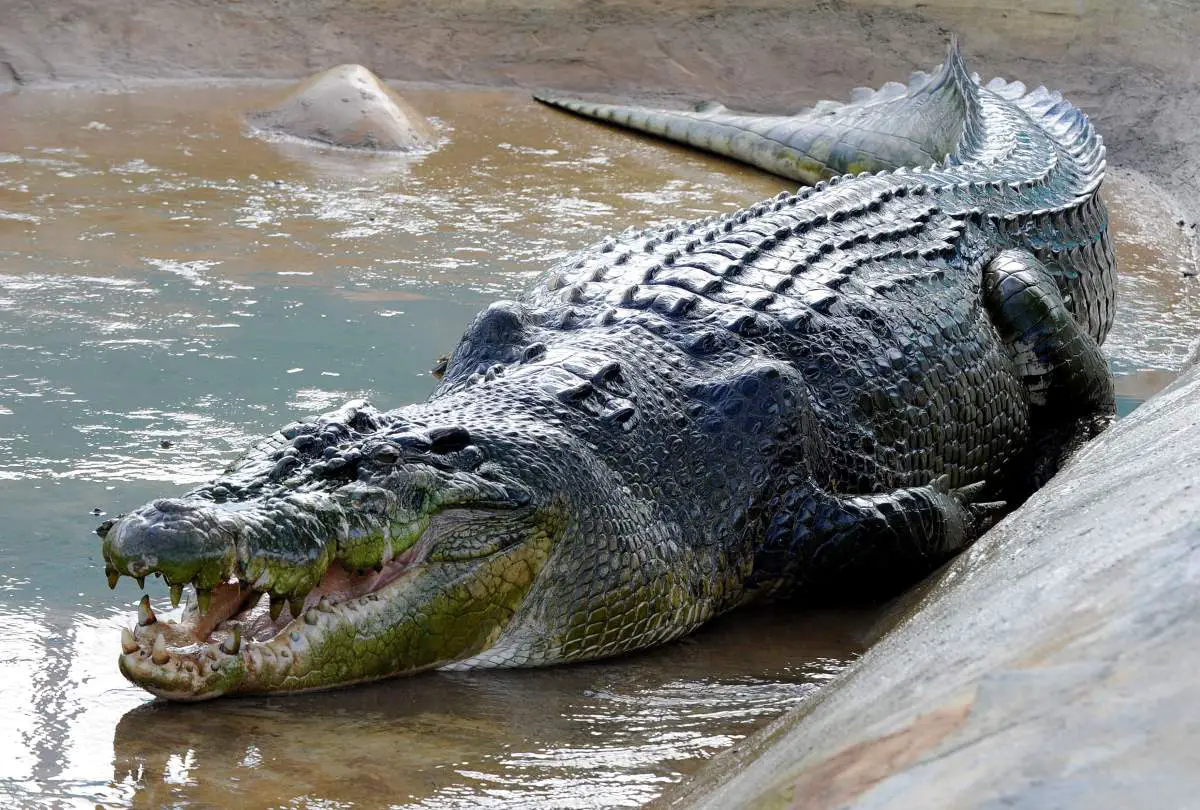
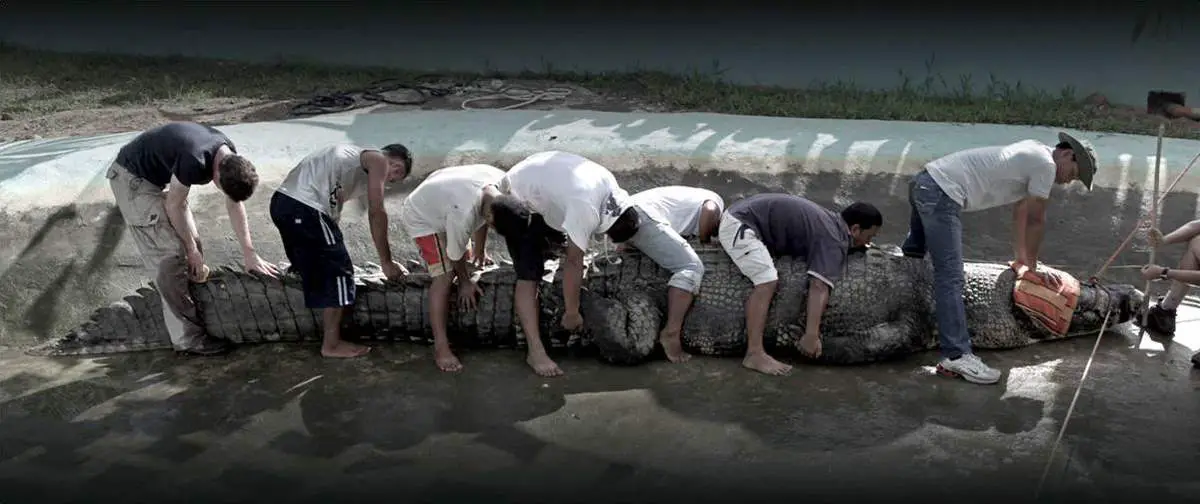
Measured at 20 ft 3 in (6.17 m), and weighed 2,370 lbs (1,075 kg), Lolong was the largest crocodile in captivity. He was also the biggest crocodile ever measured from snout-to-tail.
Lolong was an Indo-Pacific or saltwater crocodile (Crocodylus porosus). Australian crocodile expert Dr. Adam BrittonNotes 1 sedated and measured Lolong in his enclosure in November 2011, and confirmed him as the world’s longest crocodile ever caught and placed in captivity.
He was caught in a Bunawan creek in the province of Agusan del Sur in the Philippines on 13 September 2011. He was captured with the joint cooperation of the local government unit, residents, and crocodile hunters of Palawan. The giant crocodile was hunted over a period of three weeks; once it was found, it took around 100 people to bring him onto land. He became aggressive at several points during the capture and twice broke restraining ropes before eventually being properly secured. He was estimated to be at least 50 years old.
Lolong was suspected of eating a fisherman who went missing in the town of Bunawan, and also of consuming a 12-year-old girl whose head was discovered two years earlier. He was also the primary suspect in the disappearance of seahorses in the area. In the examination of the stomach contents after his capture, remnants of water buffaloes reported missing before Lolong’s capture were found, but no human remains.
The crocodile was named after Ernesto “Lolong” Goloran Cañete, one of the veteran crocodile hunters from the Palawan Crocodile and Wildlife Reservation Center, who led the hunt. After weeks of stalking, the hunt for Lolong took its toll on Cañete’s health. He died of a heart attack several days before the crocodile was captured.
Despite his initial aggressiveness, Lolong was remarkably gentle in his enclosure. Dr. Britton writes “This shouldn’t come as a surprise to anyone familiar with the effects of capturing large crocodiles from the wild. It’s a phenomenon called “capture myopathy”; the shock of being caught, poked and prodded, and introduced to a completely new and alien environment is a stressful experience, particularly for an animal as large as Lolong who has been master of his domain for decades. It might seem unusual to think of crocodiles as being susceptible to stress, but they’re just like any other vertebrate in that respect and something that anyone who maintains captive crocodiles should be aware of.”
The nongovernmental organization activist Animal Kingdom Foundation Inc., with the cooperation of People for the Ethical Treatment of Animals, had urged the local government of Bunawan to return Lolong to the creek of barangay Nueva Era, where the giant reptile was captured. But, in an ongoing debate, Bunawan mayor Edwin “Cox” Elorde and residents of the barangay opposed the crocodile’s release, arguing that he would threaten individuals living in the vicinity of the creek.
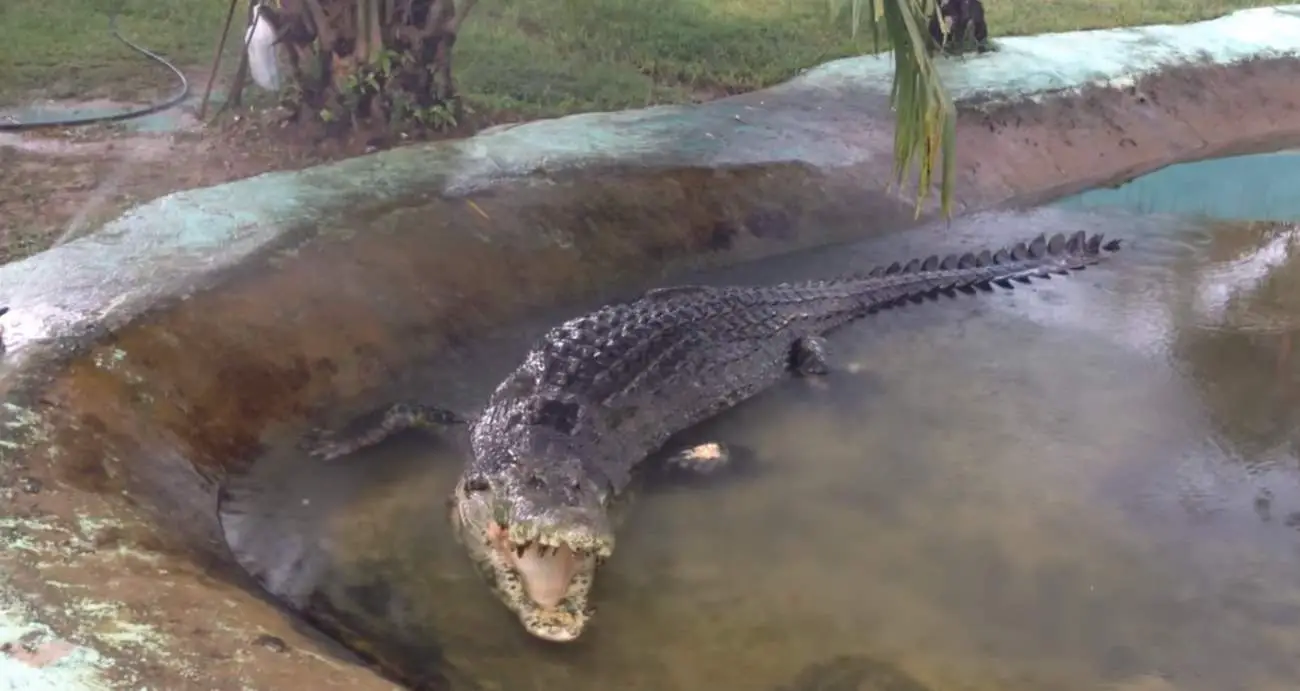
Lolong died in captivity just 18 months later he was captured, at around 8 pm on 10 February 2013. His necropsyNotes 2 revealed that he died from congestive heart failure compounded by fungal pneumonia, lipidosis of the liver and kidney failure. Here is a video which was shot when Lolong was alive:
According to Dr. Adam Britton, Lolong’s enclosure might not look pretty, but, in fact, crocodiles in the wild call muddy holes as “home”, they just look for any kind of shelter and the basic necessities for survival. So, Lolong was provided with those basic necessities. Crocodiles do not eat if they’re too stressed, but in Lolong’s case, he was eating and seemed to settle down into his new surroundings and behaving normally.
Britton also says “Anyone who actually met his caretakers would have realized he was well-loved. You might say they adored him.” He adds: “…there were also financial incentives to keep Lolong alive; he was popular, brought much money into the community, and generated a lot of national and international attention.”
So, despite his conditions look terrible to an unfamiliar eye, he was well-cared.
Britton concludes: “It would have been ideal to leave Lolong in the wild, but does such specious thinking have a place in our overcrowded world? A conflict between humans and wildlife can have major repercussions for conservation (not to mention human safety, which any level-headed human regards as being of prime importance). Yet at the same time, we can’t simply remove all wild animals simply because it makes us feel better, or safer. There has to be a compromise, and unfortunately for Lolong he was that compromise at that particular time and place. Perhaps his death can be a lesson for us.” (I recommend you to read Dr. Britton’s great article titled “What really killed Lolong?” on his blog.)
Lolong was officially certified by the Guinness Book of World Records as the “world’s biggest crocodile in captivity” at 20.25 ft (6.17 m).
Current status: dead
No. 1 candidate: Puerto Rico crocodile (6.2 meters/20 feet 4 in, up to 6.3 meters/20 feet 8 in)
After Lolong, the best-documented evidence of a record-sized crocodile comes from Obo village on the Fly River in Papua New Guinea (Montague 1983). This crocodile drowned in a fishing net set or barramundi fish and after 50 men hauled the crocodile onto the bank they found an entire Rusa Deer (Cervus timorensis) carcass in the stomach. The crocodile’s skin had already been removed and salted when Jerome Montague and one of the authors (RW) visited the village, but the skin plus decapitated head measured 6.2 m (20.3 ft). The authors considered this likely an underestimate considering possible shrinkage of the skin plus an incomplete tail tip, suggesting a TL closer to 6.3 m. The DCL of this crocodile was 720 mm (28.3 in), which at 6.2 m TL would indicate a DCL:TL ratio of 1:8.6, or 1:8.8 considering the likely 6.3 m TL. While not a complete or living specimen, this is still considered the largest C. porosus ever measured and documented.
Current status: dead
No. 1 candidate: Cambodia Crocodile (7 meters / 23 feet, probably)
Update December 26, 2017. As you can see below (see the “life-size replica” of Krys crocodile), Adam Britton mentions about a 7-meter saltwater crocodile. As far as I know, Lolong is the largest crocodile ever measured and Mr. Britton himself measured it. So, I asked him via twitter what did he mean by that. Here’s his answer:
“Lolong’s skull was 70 cm long, a HL:TL ratio of 1:8.8. There’s a saltwater croc skull in the Paris Museum, originally from Cambodia, that’s 76 cm long. Its original owner was estimated to be 7 m (23 ft) long, a HL:TL ratio of 1:9.2 which sounds about right.”
The largest known C. porosus skull is housed at the Paris Museum (MNHN PMP specimen #A11803 = old museum collection #7738) originally from Cambodia. It has a DCL (dorsal cranial length) of 760 mm (29.9 in), making it 8.6% longer than Lolong’s skull. If we apply a DCL:TL (dorsal cranial length:total length) ratio of 1:9 for this skull, TL is estimated at 6.84 m (22.4 ft) which is 11.3% longer than Lolong’s TL (total length). Although the actual TL was never preserved, these figures strongly suggest a nearly 7 m (almost 23 ft) crocodile. We can compare this with another slightly smaller skull (currently in the private collection of Shivendra Narayan Bhanja Deo, the Yuvaraj of Kanika in Bhubaneshwar, Orissa) of DCL 730 mm (28.7 in), originally from the Indian Bhitarkanika province, reported to have come from a 7 m (23 ft) C. porosus. If those figures are true then DCL:TL ratio would be 1:9.5, sufficiently high for minor skepticism but still feasible. Applying the 1:9 ratio to the Bhitarkanika skull gives an estimated TL of 6.6 m (21.7 ft). The truth is unlikely to be far from these figures and there is a strong sense that 7 m (23 ft) is likely the maximum possible length for C. porosus.
No. 1 candidate: Kalia (Bhitarkanika Park crocodile) (claimed size: 7.01 meters/23 feet)
It seems the Guinness World Record book has accepted a claim that a 23 ft (7.01 meters) giant male saltwater (named Kalia) crocodile weighing 2,000 kg lives within Bhitarkanika Park in the state of Orissa, India, but because of the difficulty to capture such a large monster, the accuracy of the measurement is yet to be verified. There’s also no photo yet.
I am skeptical about this claim, while it is much larger than any other accurately reported measurement. Adam Britton wrote: “There are several unverified reports of even larger wild crocodiles, the most popular being a 7 m plus (over 23 ft) C. porosus sighted within the Bhirtarkanika Wildlife Sanctuary in Orissa, India, in 2006 (Whitaker and Whitaker 2008). However, this was not a measurement but a size estimate taken from a boat and regardless of the skill of the observers it cannot be compared to a verified tape measurement, especially considering the uncertainty inherent in visual size estimation in the wild (Bayliss 1987). Another famous giant crocodile shot on the Norman River in Australia in 1957 was reported by the shooters to be over 8 m (approx. 26 ft). While it seems likely that an exceptionally large crocodile was shot, no actual evidence was ever taken. For a crocodile whose length exceeds that of any other record by a large margin, a high degree of skepticism is understandable when bearing in mind the track record of inaccurate or exaggerated size records (Greer 1974; Whitaker and Whitaker 2008).”
Current status: alive
What about Krys, the “Savannah King”?
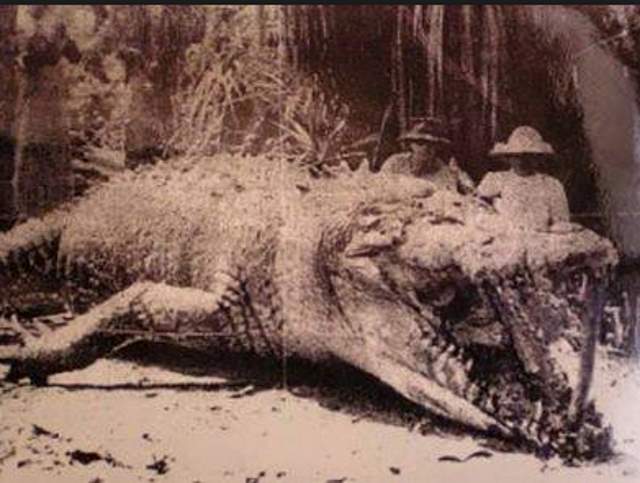
According to a story, a giant crocodile was shot in July 1958 near Normanton, Queensland, Australia. It was nicknamed Krys after the person who shot it. It was claimed at 28 foot 4 inches (8.64 meters). There is also a life-size replica of it at Normanton.


Comments
Post a Comment